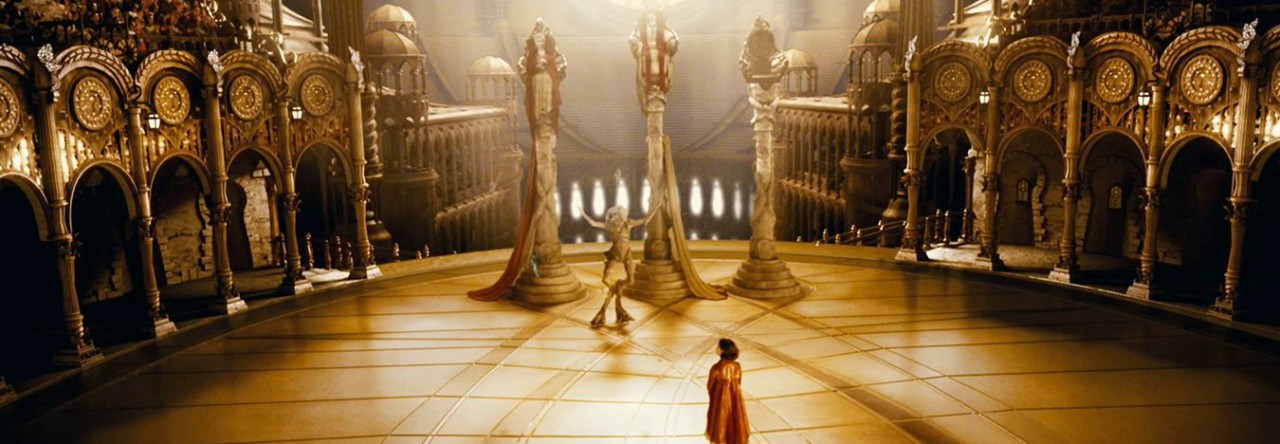
INT. EMBASSY BALLROOM – NIGHT
COLONEL O´REALLY stands by the bar – a scotch in one hand while the other rests on the thigh of a young blonde. Her shapely behind is planted on a barstool, and she giggles noisily at one of his jokes.
COLONEL O´REALLY
...so then I said to Oliver North, I said: “Ollie...”
A young officer, CORPORAL WIMP, approaches behind the Colonel´s back. His face is flustered and beads of sweat cover his brow. He clears his throat nervously.
The Colonel ignores the young officer, moving even closer to his blonde prey.
CORPORAL WIMP
Sir...
COLONEL O’REALLY
I’m busy here, son. Take a hike.
But the Corporal persists.
CORPORAL WIMP
Sir, I’m afraid it’s an emergency.
COLONEL O’REALLY
So spit it out, what is it?
CORPORAL WIMP
Well, sir...
COLONEL O’REALLY
(bellows)
Spit it out, Corporal!
CORPORAL WIMP
I think you need to see this, sir.
How many times have we seen scenes like this? Disaster movies are sure to have at least one “you need to see this” – some have close to a dozen. Is it just a harmless cliche? Or is it a sign of something worse: screenwriting advice mutated into dogma?
One of the first commandments of screenwriting goes “Show, Don’t Tell!” To be sure, that’s good, sound advice. Film is audiovisual storytelling, so your writing should be all about what can be seen and heard. But all advice must be combined with conscious thought. Otherwise you end up with insanely annoying characters that are incapable of telling each other anything. And all they can say is “I think you need to see this.”
Disaster movies are all about the spectacle. We don’t want to hear about the explosions. We need to see them. That doesn’t mean that every disaser movie has to be strictly formulaic in every scene. Sometimes a young officer can actually just tell the Colonel what’s up. It’s not always: Volcanoes = good, dialogue = bad.
An unthinking attitude to show, don’t tell, may lead to some problems:
- Fragmentation. All scenes get steeped in spectacle, so the story ends up getting “loud”. May lead to your movie ending up as a string of explosive pearls.
- Fear of dialogue.
- Fear of monologue.
- Characters behaving like cogwheels in a screenwriting machine.
- Avoiding getting close to characters, and giving them depth.
- Fear of ambiguity (what really happened?)
Keeping all this in mind, I still consider show, don’t tell, one of the best pieces of screenwriting advice you can get. You just have to remember that it’s not dogma to be followed blindly.
And that sometimes it’s really okay to tell, and don’t show.
Trond-Atle
Some excellent points! Especially the one about fear of ambiguity. I would welcome the appearance of more unreliable narrators, and characters being deceived by mere wordcraft. If done well, it really adds a new dimension to the film medium
Pål
Yeah, I’m going to write more about the fear of ambiguity. Most mainstream movies and TV shows have narrow strings of causality. A leads to B, which leads to C, and so on. The best stories (and real life) have more complex causalities.
I’m reminded of the Sopranos finale. A lot of people were angry and confused about that episode. But didn’t they notice that the show had always been narratively unusual? Had they expected the finale to be neat, tidy and devoted to tying up “loose ends”?
Trond-Atle
I agree, I love that ending. It made me angry at first, because my natural curiosity wanted to KNOW. But eventually I truly appreciated the opportunity to ponder and speculate.
Christer
One day I’m gonna write the line…
“I don’t think you need to see this, sir.”
Pål
Christer: Save that line for when we write “Speech Impediment”. I want to write a scene where our heroes are in a tight spot, and they grab their cellphones: “Thank God the cellphone works, and the reception is good!” Then they call for help, and get rescued in good time.
Christer
You got it!